

Who makes them
Our IGLO profiles are manufactured by Drutex S.A., one of Europe’s largest window manufacturers, certified to ISO 9001 and to AS 2047 for the Australian market. Oknalux is listed with WERS, the Window Energy Rating Scheme.
All profiles are A-class and extruded from prime material rather than recycled stock. That distinction matters more than it sounds: recycled PVC profiles have inconsistent density and lower impact strength, which shows up as brittleness and colour drift over a twenty-year service life. A-class prime material is the specification you want and it is not universal in this market.
Hardware is Maco Multi Matic KS throughout, with two anti-burglary bolts as standard, and anti-burglary classes RC 2 and RC 2N available on request.
Thermal performance
Manufacturer-tested whole-window U-values, EN 674, on a 1230×1480mm window:
| Profile |
Uw |
Standard glass package |
| IGLO Light |
1.0 W/m²K |
Ug up to 0.7 W/m²K available |
| IGLO 5 |
0.94 W/m²K |
Ug 1.0 W/m²K standard, 0.7 available |
| IGLO Energy |
0.79–0.89 W/m²K |
Ug 0.5 W/m²K standard; 0.3 with krypton-filled quad |
IGLO Energy with a krypton-filled four-pane package reaches a glass U-value of 0.3 W/m²K, which is Passive House territory.
Why Australian and European U-values differ. Australia tests on a 600×1500mm window, Europe on 1230×1480mm. The European sample has proportionally more glass and less frame, so it returns a higher, more conservative figure for the same product. A window returning 1.6 in Australia may return 1.9 in Europe. The figures above are European. See our [technical info page] for the full calculation method.
Reading the specification
Chamber count is the number of sealed air pockets in the frame cross-section. More chambers means more resistance to heat transfer, because each still-air pocket interrupts conduction. Five is standard. Seven is high performance.
Frame depth determines glass capacity. A 70mm frame takes up to 40mm of glass, enough for a double glazed unit with a wide cavity or a slim triple. An 82mm frame takes 48mm, enough for full triple or quadruple glazing.
Sealing is where most window failures start. Double EPDM means two continuous rubber seals between sash and frame. Triple means three. EPDM stays flexible far longer than the cheaper alternatives, which is why a well-sealed uPVC window still shuts tight after twenty years.
Reinforcement is required. Australian conditions demand steel inside the profile for structural stability and wind load resistance. The trade-off is that steel conducts, so on IGLO Energy we offer glass fibre reinforcement instead, which improves thermal performance by removing that bridge.
uPVC Window Styles
Tilt in from the top for secure ventilation, turn fully inward for maximum airflow and inside cleaning.
Top-hinged and outward opening on the IGLO Premier frame, with multi-point locking.
Casement Windows
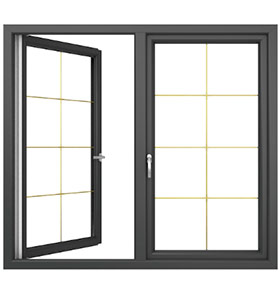
Side-hinged and outward opening for a full clear opening.
Fixed Windows
No opening sash, so the best thermal and acoustic performance available.
Sliding Windows
Horizontal sliding sashes where a swinging sash would obstruct.
What uPVC Is and Why It Suits Windows
uPVC is unplasticized polyvinyl chloride. Standard PVC has plasticisers added to make it soft and flexible, which is what you want in cable sheathing or vinyl flooring. Leave the plasticisers out and the material stays rigid and dimensionally stable, which is what you want in a window frame.
That rigidity is the whole point. A window frame has to hold its shape across decades of thermal cycling while carrying glass weight and wind load. Plasticised PVC would creep and the seals would progressively lose compression. uPVC does not.
uPVC was first extruded into window profiles in Germany in the 1960s and became the dominant frame material across the UK, northern Europe and much of the United States. Australia adopted it later, largely because aluminium was cheap and energy efficiency was not regulated. Both of those conditions have changed.
Key Properties
Thermal performance
uPVC has very low thermal conductivity. Combined with multi-chamber geometry, the frame contributes to insulation rather than undermining it. This matters more than people expect: the frame is typically 20 to 30 percent of a window’s area, so a conductive frame can waste a large share of what double glazed glass delivers.
Acoustic performance
uPVC damps sound as well as heat. Paired with double glazing, IGLO 5 delivers 34 to 44 dB reduction and IGLO Energy 35 to 46 dB, depending on the glass package. Acoustic laminated glass with asymmetric pane thicknesses pushes this further by disrupting resonance between the panes.
Dimensional stability
No rust, no rot, no warping, no swelling. uPVC does not respond to humidity the way timber does or corrode the way steel and aluminium can in coastal air.
UV and colour stability
Profiles are UV-coated with a titanium dioxide sunscreen additive. Colour comes from Renolit foil laminated to the profile, not surface paint, so there is nothing to chalk, flake or fade off.
Security
Maco Multi Matic KS hardware with two anti-burglary bolts as standard, plus a frame blockage that prevents the sash being lifted externally. Bolts screw directly into the steel reinforcement rather than into the plastic.
Low maintenance
Warm soapy water occasionally. No painting, sealing or re-treating.
uPVC vs Aluminium vs Timber
|
uPVC |
Thermally broken aluminium |
Timber |
| Frame conductivity |
Very low |
Moderate |
Low |
| Lifespan |
20–35 years |
Up to 45 years |
35–45 years |
| Maintenance |
Occasional wash |
Occasional wash |
Repaint or re-treat, roughly annually |
| Corrosion |
None |
Salt pitting possible |
Rot risk |
| Upfront cost |
Lower |
Higher |
Higher |
| Finish range |
30+ foils incl. wood-grain |
Very wide |
Widest, real timber |
| Condensation risk |
Lowest |
Higher |
Low |
| Recyclable |
Yes |
Yes |
Yes |
Aluminium outlasts uPVC as a material and thermally broken aluminium is a genuinely good product, it simply costs more to reach the same thermal number. Timber is the right answer where heritage requirements or design intent demand real wood, and we supply it. uPVC wins on cost-to-performance for most residential applications, which is why it dominates in the markets that regulated window performance earliest.
We supply aluminium windows, timber windows and composite wood-aluminium windows as well.
uPVC Double Glazed Doors
The same frame properties apply to doors. Our uPVC door range includes sliding doors, French doors, bi-fold doors and entry doors, all available in matching profile systems and foil colours so windows and doors read as one system.
Colours and Finishes
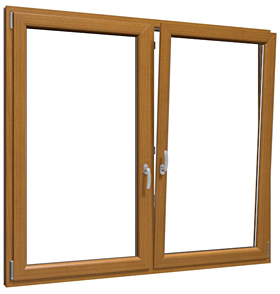
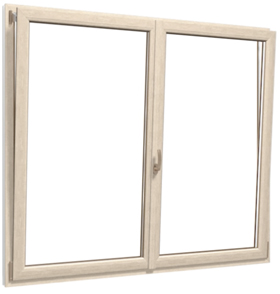
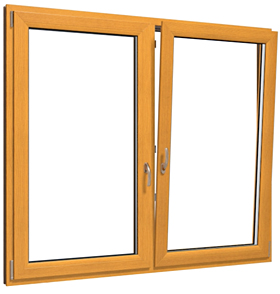
Over 30 Renolit foil colours, including smooth solids, textured finishes and wood-grain effects such as Golden Oak, Walnut, Mahogany, Winchester and Whitewashed Oak. Different colours can be specified inside and out, so you can run anthracite externally and white internally.
Cores are available in white or brown.
Where We Supply and Install
Oknalux operates from showrooms in Adelaide and Sydney and services South Australia, New South Wales and the ACT.
uPVC Windows Sydney → | uPVC Windows Adelaide → | uPVC Windows Canberra →